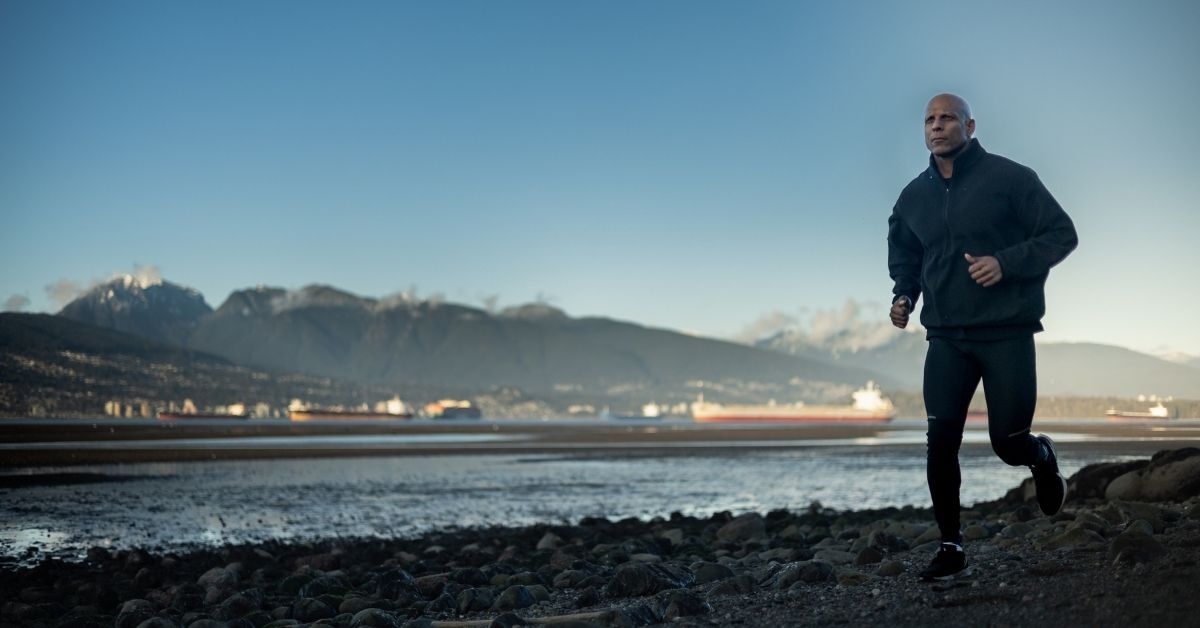
About a year ago, I started a grueling cross-country marathon that pushed my body past its breaking point. Today, I’m finally feeling what I call “back to normal”.
Running across Canada for mental health ironically took a massive toll on my own wellbeing. For a long time after the finish line I was physically and mentally exhausted. But the recovery process taught me a hard lesson: sometimes the most productive thing you can do for your health is to completely stop, rest and reset.
That’s why I’m joining the Canadian Men’s Health Foundation (CMHF) as a National Champion. For me, this role isn’t a vanity badge or a pat on the back. It’s a partnership built on credibility and collaboration.
Facing hard things face-first
Going back even further — to 2019 — my life looked very different. I was navigating a career in border security, a difficult divorce and immense life stress. Like a lot of guys my primary outlets were purely physical. Lifting weights and training in jiu-jitsu were my go-tos.
Then the pandemic hit and those outlets changed dramatically overnight. Without the gym or the mats I found myself relying on drinking to cope. Realizing I needed a drastic change as well, I grabbed a copy of David Goggins’ book Can’t Hurt Me. The core message about chasing adversity really stuck with me.
I didn’t start running because I loved it. I started because I absolutely hated it, but I wanted to face my own adversity head-on. While the average guy might not relate to bodybuilding or martial arts, I knew everyone could understand the raw struggle of running even a single kilometre.
And boy did I ever run with that idea. From 2020 to 2025 I ran a total of 21,000 kms. That included tons of training to get me ready alongside the big race challenges I also took on.
When I started my run last year it was meant to be a coast-to-coast trip of 7500 kms. Then my crew chief, Glen, and I made a drastic shift. Instead, we dropped the daily distance from 100 to about 55 kms a day across 55 cities so we could run to people, not past them. Even with that I still ended up running over 70 ultramarathons worth of races in one go.
The result? Strangers began approaching our RV at every stop, eager to open up about what’s been weighing on them. I didn’t think we’d have that many people come. We were just there to listen.
To date I’ve been able to collect roughly $300,000 donations for mental health. True to my own style, I don’t plan on stopping there.
Deconstructing my mental health toolkit
During my own recovery I dove deep into mental health practices. From there, I began looking at things like anxiety and depression differently. I began to realize they aren’t a permanent, unchangeable state of existing — they’re complex responses to life challenges.
I sometimes struggle with these things still. I’ve been diagnosed with depression and it reminds me that I need to pay attention to my own body and mind with whatever I do.
When it comes to treating those challenges we need to remove the shame around tools like therapy or prescriptions from your doctor. If you break your leg you need a cast and crutches to heal. Medication can be a vital, short-term support when you’re in a dark place. Eventually, the cast comes off and you need a long-term lifestyle program to keep you moving forward.
Here’s what my daily mental fitness toolkit looks like:
- Varying Physical Discipline: I change my activities every now and again to help introduce new and exciting challenges.
- Nature Immersion: Getting outside helps me clear my mind and restore mental fatigue.
- Structured Mindfulness: Making quality time to sleep or reset helps me manage anxiety spikes and regulate myself.
- Honest Human Connection: Sitting down with like-minded guys over a coffee or on the jiu-jitsu mats breaks down the walls of loneliness.
Fatherhood at the halfway mark
At 48 years old, I’m a single dad to a nine-year-old daughter. Recently, it hit me that I’m exactly at the halfway mark of her childhood before she turns 18.
Knowing that a child’s psychological foundation forms heavily during the early years, I’ve shifted my priorities. I live just five minutes away from her and actively protect my parental schedule. Grand public gestures have taken a backseat to the small, vital moments like showing up for soccer practices, and going to her games while making sure I’m really there when I show up.
Balancing community-level advocacy with family presence is how I choose to model what it means to be a capable man while prioritizing connections that mean the most to me.
Progress over perfection
I didn’t figure everything out overnight. My path has been full of mistakes. I used to think being a “hard charger” meant going full throttle 100% of the time, but strength also means knowing when to pause.
Improving your overall health can be simple, if you allow it to be. For me it began with the willingness to stop running away from my problems. Whether that means connecting with a friend, stepping outside or asking for help, you just have to start today.
Feeling off?
Start here.
Free tools to help you deal with stress, anxiety, and tough stretches.