On a cold November night in 2020, Brandon Hay was looking over the balcony of his 10th floor apartment.
“If I were to die right now, would anyone miss me?” he thought to himself. While COVID brought with it a universal feeling of isolation there was also something deeply personal.
Hay’s marriage of 16 years had just ended in divorce and this was the first time he’d moved to a new place all by himself. Standing there, questions about who he was as a man, a husband, and a father started to surface. “I hadn’t talked to my kids. I worked a remote job and wouldn’t talk to anyone,” said Hay.
Not long afterwards, Hay made a snap decision. “I put on some clothes quickly and drove to my kids’ house. My eldest son gave me this huge hug. I can’t explain how I melted in his arms,” he said. “I was always a ‘supporter’ as a dad. This was the first time one of my kids was like a supporter to me.”
Hay decided to use that vulnerable moment. He built an initiative that brings men facing isolation together: Sunday Dinners. A virtual and in-person gathering where Black men come together over food to talk, listen and remind each other they’re not alone.
Hay knows the plight of men and fathers facing loneliness well. A Jamaican immigrant and father of three sons, he founded the Black Daddies Club in Toronto in 2007, a space for Black men and fathers to talk openly, push back on negative media portrayals, and support each other’s mental health.
He joined Dr. David Kuhl, vice-president of Research and Knowledge Mobilization at the Canadian Men’s Health Foundation and a UBC Professor, on the Don’t Change Much podcast for an honest conversation about what it really takes to show up as a father.
‘The key thing is that we don’t feel alone’
Sunday Dinners started as a way to fill the lost spaces where men would usually gather before COVID, like barbershops and restaurants. But it quickly became its own ‘third place’ where fathers felt comfortable opening up.
“A lot of the things that we’re navigating are coming from a place of shame. However, when another man is talking about the same thing, something shifts,” said Hay.
Today, Hay brings his training in Gestalt therapy to make Sunday Dinners more structured and intentional. Gestalt therapy is an approach that focuses on what a person is feeling and experiencing in the present moment, rather than analyzing the past.
“When men leave a Sunday Dinner they’re like, ‘I feel like I’m ready to take on the week.’… The key thing is that we don’t feel alone,” said Hay.
How to make fathers feel less alone is a topic Dr. Kuhl knows well. He has spent decades exploring fatherhood as a public health issue. His research looks at the impact of fathering and around being fathered. Kuhl’s most recent contribution can be seen in the State of the World’s Fathers report, one of the only global studies of its kind, surveying 8,000 parents and caregivers across 16 countries to better understand the pressures, challenges and experiences of fathers worldwide.
Dr. Kuhl’s father was physically present but emotionally aloof. A childhood experience that shaped his commitment to becoming a better father and to building programs that help other men do the same.
Hay’s father was defined by tragedy. His father in Jamaica was murdered, leaving him to figure out fatherhood entirely on his own.
A lot of us don’t have a manual when it comes to fatherhood. A lot of us are walking the path and figuring it out as we go.
Both men had to figure out — without a roadmap — what it actually meant to show up.
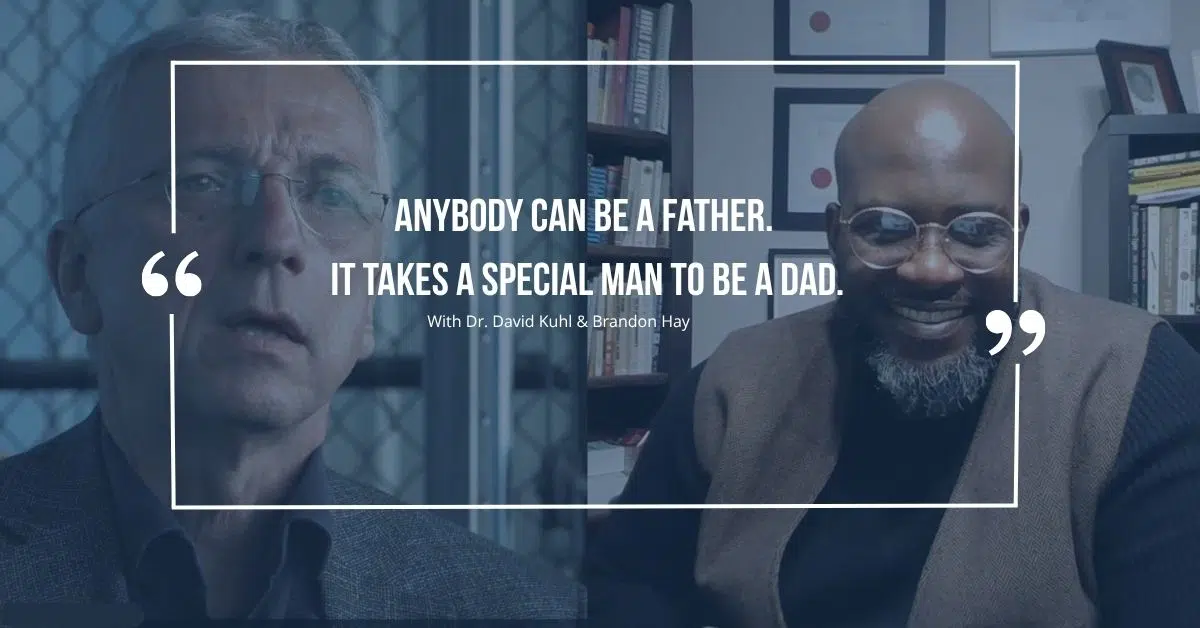
“Anybody can be a father. It takes a special man to be a dad,” said Dr. Kuhl.
When it comes to working with men, setting matters as much as the conversation. Men open up differently when they’re in motion or doing an activity together.
“Take them for a walk in the woods and you’ll get much further than when you’re in an office having them sit across from you,” said Kuhl.
Go where the men are
Hay’s work has consistently met guys wherever they’re at in life. Early in his career, he noticed what worked for mothers didn’t work the same way for fathers. The ‘if you build it, they will come’ approach simply didn’t apply.
“You have to build it with these men. And then you have to go to where they’re at,” said Hay.
That was the founding philosophy of Black Daddies Club, and it still is almost two decades later. Instead of building a program and waiting, Hay went to where Black men already were: barbershops. In Toronto (specifically in the Little Jamaica neighbourhood) barbershops were one of the few places where Black men lowered their guard and spoke openly.
“You see the masks slowly come down,” said Hay.
From those early sessions, he listened to what fathers actually wanted and needed. He built programs around those conversations including Daddies and Me. A program where groups of Black fathers and their children attend Canadian football games, Cirque du Soleil and exhibitions at the Art Gallery of Ontario. The club also organized taboo discussions where men tackled topics otherwise considered difficult or off-limits, weekly family hikes and visits to fathers inside prisons in Ontario.
For every dad figuring it out
On the surface, Hay and Dr. Kuhl seem to have little in common. One is a Black Jamaican immigrant navigating his own healing and now training to become a therapist. The other, a white Canadian-born physician and scholar who has spent decades studying men’s health and fatherhood. Yet both are drawing on their relationships with their own fathers to help other men become the dads their own fathers couldn’t be.
Dr. Kuhl said a key test as a dad i is when your kid pushes you to your limits. In those moments, knowing yourself matters more than anything.
“You’re gonna get angry. It’s what you do with the anger and how you express it that makes a difference. If you have to step out of the room because you’re gonna say or do something you’re gonna regret, recognize that so you can actually step out of the room,” said Kuhl.
For Hay, it’s about finding your tribe.
If I’m in a space with all Black men, it’s not a workshop. It’s a ceremony.
“And a person in that room is going to say something that’s going to resonate with me in a way that I’ve never verbalized before. Even as I’m talking, I’m getting goosebumps.”
Hay is not seeking perfection as a father. But he keeps showing up, trying to make fathers feel seen and less alone. Because ultimately that’s what changed him.
“I wanted to do fathering differently than how I experienced it.” And according to Kuhl, Hay is already winning.
“We need more people like Brandon. To build a community that’s defined by men for men, it is the beginning,” said Kuhl.
“Be a Brandon!”
Feeling off?
Start here.
Free tools to help you deal with stress, anxiety, and tough stretches.