
2026 State of Canada’s Fathers Study
Between providing and caring: Economic stress, caregiving, and gender norms in Canada May 26, 2026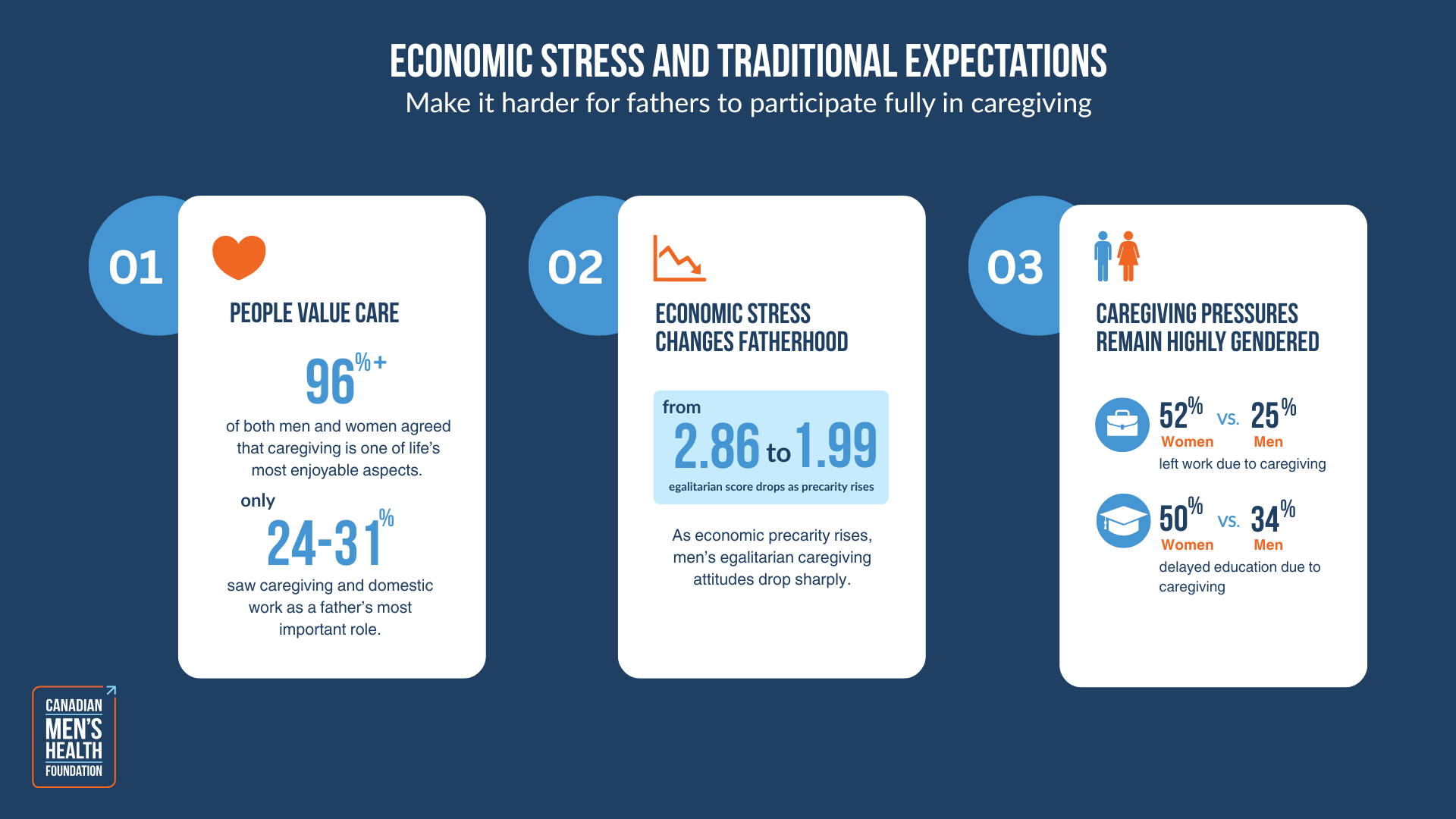
The Canadian Men’s Health Foundation (CMHF) recognizes fatherhood as one of the most powerful and underutilized entry points in men’s health. CMHF is committed to supporting men through fatherhood not as a niche program concern, but as a core strategy for building healthier families, reducing downstream, system burden, and strengthening communities across Canada. Research consistently shows that engaged fathers produce measurably better outcomes for children in cognitive development, emotional regulation, and long-term mental health. Moreover, men who become fathers are often uniquely open to health engagement, making the transition to parenthood a critical window for early intervention.
CMHF is Canada’s only national organization conducting applied research on fatherhood as a men’s health issue, including its ongoing Canadian Fatherhood Study and participation in an international men’s care study spanning 16 countries. The State of Canada’s Fathers, 2026 report draws on key findings from the Canadian sample of the international study, and shows that economic precarity, traditional gender norms, and unequal distribution of caregiving continue to shape fathers’ wellbeing and family dynamics.
Key findings
1. Economic precarity drives a cascade of negative caregiving outcomes for both genders, but hits men’s egalitarian attitudes hardest.
The regression analyses show that economic precarity is the strongest predictor of caregiving burden (those in the highest precarity group reported more than three additional burden items than those in the lowest group). More strikingly, as economic precarity rises, men’s egalitarian caregiving attitudes drop sharply—from 2.86 to 1.99 on the scale—while women’s decline is modest (2.83 to 2.51). This means that economic stress doesn’t just squeeze families financially; it actively pushes men toward more traditional gender views, making equitable household arrangements less likely during periods of significant stress.
2. The caregiving burden is gendered, substantial and self-reinforcing.
Women are significantly more likely than men to leave work entirely (52% vs. 25%), delay education (50% vs. 34%), and stay in precarious employment (49.5% vs. 37.2%) due to caregiving responsibilities. Since care burden is also a significant predictor of poorer wellbeing (each additional burden item increases distress scores), and economic sacrifices increase women’s long-term financial vulnerability, the system effectively compounds inequality over time. Women shoulder more care work, sacrifice more economic opportunity, and end up more financially precarious as a result.
3. Traditional gender norms persist widely, even as people abstractly value care work.
While 97.5% of women and 96.7% of men agreed that caregiving is one of life’s most enjoyable aspects, majorities of both genders (55–60%) still endorsed the male breadwinner/female caregiver division, and roughly 70% identified financial provision as a father’s core role. Only about 24–31% saw domestic and care work as a father’s most important role. This gap between valuing care in principle and recognizing it as central to fatherhood in practice is one of the most important insights from this study. It explains why progressive attitudes alone haven’t shifted household labour arrangements, and why policy interventions may be necessary to help shift entrenched behavioural patterns.