If you’ve ever worked a job site you’ll know the unspoken rule of keep going. “Walk it off.” “You’re fine.” It’s an attitude that builds bridges and pulls resources, but it’s also breaking the foundation of the very men who spend their working lives dedicated to building yours.
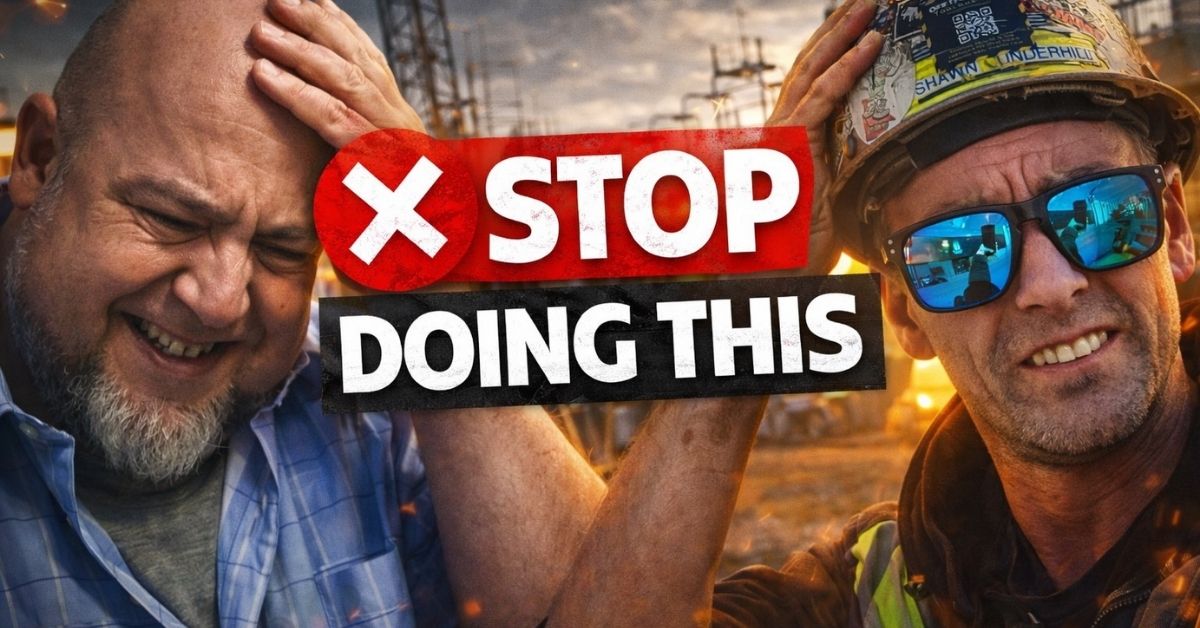
Recently, podcast hosts Mike Cameron and Trevor Botkin sat down with two guests who know that tension from the inside out. Sean Underhill, a veteran ironworker, and James Bosley, a former oil worker turned Pain BC counsellor. What they managed to unpack between each other brings a whole new level of clarity to the struggle many trades guys face.
Working like athletes but without the support team
Sean Underhill doesn’t dance around what it feels like to be working in the trades. “I felt like an athlete when I was on the job,” he says. “Our bodies were running like an athlete, except you’re doing it all day.”
Trevor Botkin pushes on exactly that. If they’re working like athletes, are trades workers being treated like athletes? The answer everyone agrees with is ‘no’. Professional athletes have physiotherapists, performance psychologists, and massage therapists in their corner. Tradespeople have the expectation that they’ll show up and push through whatever the cost may be.
It’s a gap that has consequences far beyond just sore muscles.
“I got this”— the loneliest three words on the planet
Mike Cameron names the cultural reflex that runs through trades culture with striking clarity. The infamous “I got this.”
Those can be the loneliest three words to hear, according to Mike. It’s grit repackaged as isolation, and for many tradespeople it’s the only language they were taught.
James Bosley offers a different idea on where that reflex comes from. “A lot of times ‘I got this,’ is the trauma response that we got used to …to adapt to not having the help.” He describes it as a coping mechanism that hardened into habit.
And it has real, physical consequences on the job. “A lot of times it can lead to injuries or accidents,” James says, “because somebody is just, ‘I got it,’ but they’re being complacent.” He’s seen it go further than accidents. He’s been on sites where people didn’t go home.
Sean adds what’s missing from the other side of the equation. A safe place to say otherwise. “There was no space for you to go. There wasn’t a safe space. There was no area you felt you could just go, be vulnerable and say, ‘I need help.'”
When the body breaks from chronic pain
James’ path to Pain BC didn’t start with a career pivot. It actually started with a fall.
In 2016, James was working as a roll-off truck driver on Vancouver Island. One day while he was rolling a tarp over a garbage bin, he stepped on a piece of cardboard and dropped eight or nine feet to the bottom of that bin. He kept working. A week or two later he went to the hospital. The results were inconclusive. He was told they’d be in touch. So he kept working six days a week, up to 75 hours.
Months later when he finally saw a specialist, the doctor asked where his cast was. It turns out James had been walking on a shattered heel for six months. By the time he understood the seriousness of his accident (a broken leg, broken hip, and blown disc) he’d spent over a year compensating, overworking and making everything worse. When he finally stopped, the stress of not knowing when he’d return to work compounded everything.
“The majority of that pain that rose was because of the stress,” James says now. “The lack of sleep, the lack of nutrition, all of those things are factors.”
That’s not a small insight. It’s the foundation of how he now understands pain itself.
It’s not “all in your head” but it is in your brain
One of the most important threads in this episode is James’s explanation of neuroplasticity and chronic pain translated into a way others can understand.
“Your brain becomes so efficient at going to pain, pain, pain, pain that even when you’re not injured, it’s still going to pain, pain, pain,” James explains. That’s neuroplasticity working against you. The good news though is it can be reversed.
You can recreate new pathways.
James is currently taking a course in pain reprocessing therapy and he opens up about a deeply personal example — a decade of recurring, debilitating pain that no test could explain which became more intense during times of extreme stress. When he came across the same case described in his course, something clicked. He started telling himself, “I notice the pain now, but I’m okay. I’m not injured.” The pain, he says, has largely gone away.
He speaks up about his frustration around how this pain is understood by some practitioners.
“A lot of doctors will just tell you it’s in your head. Technically yes, all pain is in the head, because that’s where the senses are.” But that’s only half the explanation, and without the other half — the social and environmental factors, the role of sleep, food, home stress, unprocessed trauma — it just sounds like dismissal.
He points to the work of Canadian physician, Dr. Gabor Maté, who while working at a hospice found that the majority of his patients’ suffering traced back to unprocessed childhood trauma. None of this is weakness, it’s neurological. All of it is normal.
A brotherhood that seeks change
Sean speaks clearly about there being a brotherhood in the trades. He’s also clear that it’s broken.
“As an iron worker, it was a brotherhood, but it was a different branding of brotherhood, a different culture. It’s a broken culture. It needs to be changed.”
Now, what would a healthier version look like? Trevor frames it as a systemic question. What would the skilled trades sector look like if support was built in? Maybe it’s therapists on staff, physiotherapists accessible and a culture that asks us to heal instead of sucking it up. People learn from others who haven’t resolved their own traumas, and the cycle perpetuates itself.
We come in with a little bit of baggage and the trades don’t know how to deal with that.
Sean’s story makes the cost of that concrete. Early in his career, a serious injury led to opioid prescriptions. Three weeks later, he was rushed back to work with the same bottle still in his pocket. “I did not know how to navigate it,” he says. “And then when you cut off that medication and still in that pain, without any of this awareness or the community groups and knowledge. If you’re unequipped to deal with it, you can end up in a scary situation.”
Training for life, not just the job
The shift these guys are pointing toward isn’t about a dramatic overhaul. It’s smaller and more sustainable than that.
“Start making these little [changes] and gain that traction,” Sean says, reflecting on his own recovery. “The more you talk about it, the more you hear, the more you relate, you connect.” He looks back at where he used to be with pain and what’s opened up since. The opportunities to show up for his kids, his nieces and nephews, his community. “It’s catchy,” he says.
Mike circles back to the athlete analogy to close it out. If professional athletes get entire support teams, why wouldn’t we build the same for how we live our lives? Therapists, friends, organizations like Pain BC. “They are out there,” he says. “They’re just sometimes a little bit invisible, and that’s why we’re having these conversations.”
Trevor offers the reminder that courage can be contagious. Sitting across from two working men willing to talk this openly, he says what’s been in the room the whole episode. “I really think what you guys have said today is going to connect with somebody that needs to hear it.”
Resources
If any of this speaks to you, know that there are places to turn to. James Bosley and Pain BC are a great starting point. They run The Guideline, a text support line specifically for people in the trades (available Monday to Thursday, 1 p.m.–8 p.m. PT), designed around the hours you actually work, not bankers’ hours.
Beyond that, here are a few other resources worth exploring:
- Employee Assistance Programs (EAP): Learn how EAPs can provide confidential support for workplace mental health and personal challenges. Read more at CCOHS.
- Addressing Stigma at Work: Understanding how to recognize and reduce the stigma around mental health in the workplace is a crucial first step. See the CCOHS guide.
- Canada’s Building Trades Union 2025 Mental Health Report: A report that highlights union support and outlines national commitments to member well-being. View the full report.
Feeling off?
Start here.
Free tools to help you deal with stress, anxiety, and tough stretches.