
For most of his life, Trevor Botkin thought he knew what being strong meant.
“What I thought [strength] was, was the ability to just sustain torture, the ability to sustain depression for long periods of time without help, to get through long days, to work overtime. To really run on the fuel light for the longest period possible.”
It seems he had it all backwards.
In a recent episode of the Don’t Change Much podcast, Trevor and co-host Mike Cameron sit down with Dr. David Kuhl, VP Research & Knowledge Mobilization at the Canadian Men’s Health Foundation and a UBC Professor.
Together, they talk about what real personal strength actually looks like. Which, as it turns out, is not what most of us were taught.
Real strength isn’t about running on empty
Dr. Kuhl has spent years working with first responders to guide them through handling stress, adversity and trauma without falling apart.
His take? Resiliency, as he calls it, isn’t about how long you can tough it out. It’s about maintaining or getting back your wellbeing when life hits you hard.
“It’s influenced by many factors,” Dr. Kuhl explains. “The world we live in, our social network, our biology, our psychology. It’s all of those factors that interact to enable us to gain or maintain or regain wellbeing at any time of our life despite exposure to adversity, stress, or trauma.”
You need to take care of yourself to actually be strong.
Trevor learned this the hard way. For years, he thought strength meant running himself into the ground. But when he started taking care of himself — eating better, sleeping better, actually dealing with what was going on inside — something changed.
The more I take care of myself, the stronger I’ve become. My ability to deal with stresses and pressures…has never been so confident.
You wouldn’t keep loading up the squat rack without eating, sleeping or recovering. Eventually the bar’s coming down on you. Your head works the same way.
When you feel nothing, you’re actually feeling something
One of the things Dr. Kuhl talks about with first responders is numbness. And here’s what he tells them: “Numbness is a feeling.”
That might sound weird, but think about it. If you’re feeling nothing about something that should matter, your body is saying something’s up.
“Numbness is an awareness that there’s something there that isn’t,” Dr. Kuhl says.
A lot of guys go numb because we learned early on that feelings weren’t okay. “Don’t cry.” “Be tough.” “Be strong.” Your dad may have said it. Maybe even your boss said it. Most likely, you’ve been told these things at some point in your life.
So you learned to shut it down.
But, the reality is you can’t just shut down the hard feelings.
If you suppress one of them, you suppress all of them. So it affects your degree of joy, happiness, other things as well.
Trevor experienced this firsthand. His substance use helped him numb out the hard stuff, but it robbed him of the good stuff too. “My life had just become so gray. There wasn’t even 50 shades of gray. It was just mute.”
Toughing it out doesn’t make feelings go away. It just makes you feel like something’s wrong with you for having them in the first place.
“I must be broken because these guys are doing it. My dad did it. All these other people who know better than me told me I shouldn’t be feeling these.”
Mike had a similar wake-up call. After he left the business he’d built over 20 years, something felt off. But he couldn’t put his finger on it.
It took six years (and his partner noticing something was wrong) before he realized he’d been carrying shame about how he’d handled the exit.
Warning signs you might be going numb
- Avoiding conversations that you know you should be having
- Over-explaining situations to make yourself feel better about them
- Feeling “off” in ways you can’t quite name
Your body doesn’t lie. If something feels off, there’s probably something there worth looking at.
Do you have someone you can call at 3 AM?

Dr. Kuhl’s core advice for building real strength is to know one person, absolutely, who has your back 24/7.
“Just knowing you have that person makes you stronger,” he says. And this is actually backed by research.
This isn’t just some buddy you grab beers with. This is someone who:
- Won’t judge you when you screw up
- Cares about your welfare first, before anything else
- You can call in the middle of the night if you need to
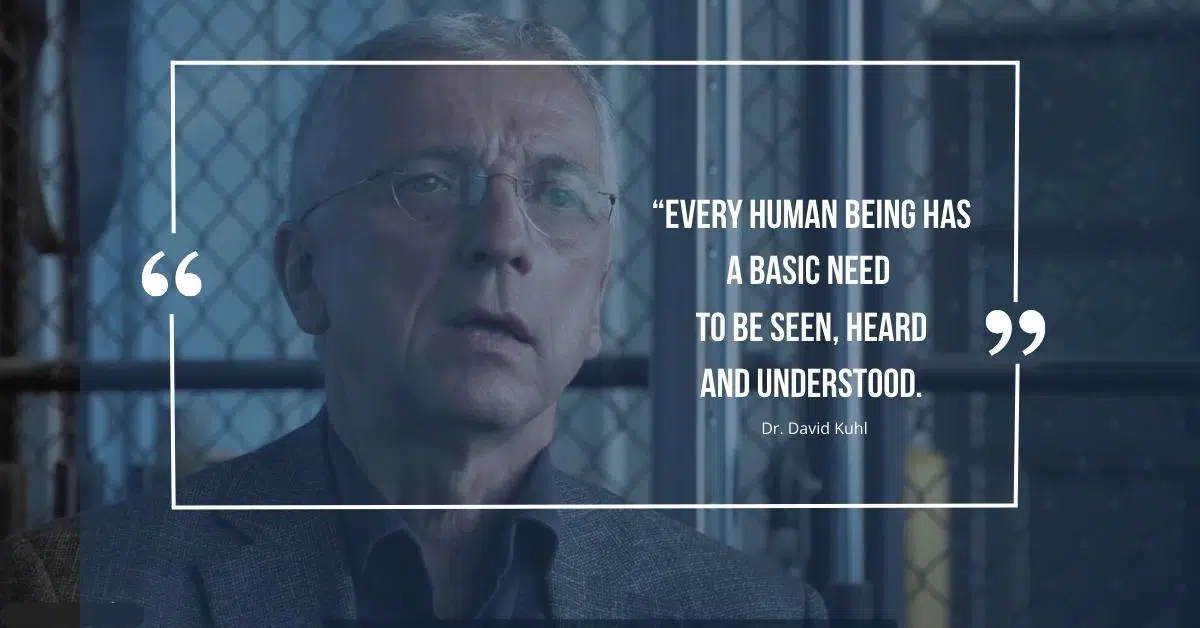
Dr. Kuhl puts it simply. “Every human being has a basic need to be seen, heard, and understood.”
When you mess up (as well all do) you need someone who can help you understand that while you made a mistake, you’re not a mistake. There’s a difference.
Trevor admits this was tough for him to accept. “I told myself a lot of things that weren’t true. I convinced myself that nobody had my back.”
But when he finally started being honest with people, he found out he was wrong.
There was a lot more people had my back than I had told myself.
So ask yourself, who is that person to you?
If you can’t, who’s the person in your life where there would be the least risk to say, “Sometimes when I wanna talk to somebody, you’re a name that comes up in my mind”?
Don’t convince yourself that person doesn’t exist. You might be surprised.
The strength in being honest
Mike’s experience with shame almost cost him his relationship. His partner could tell something was off. That what he was saying didn’t match what he was feeling.
The word she used that struck Mike was incongruent.
“This is not congruent with who I know you to be,” she told him. “Therefore, that trust is going down and we need to figure that out.”
That’s the thing about trying to hide what’s going on inside. People can sense it. And when your feelings don’t match your words, trust goes down.
Dr. Kuhl calls this what it is: “Vulnerability is honesty.”
Being honest about what you’re feeling, even when it’s uncomfortable, actually makes people trust you more. Not less. And when you take that risk and it works out? You get even stronger.
“If emotions didn’t serve a purpose, evolution would’ve gotten rid of them long ago,” Dr. Kuhl points out. They’re still here because they do something. They give you information. They guide you.
Mike learned this through some of the hardest experiences of his life. “I had an incredibly painful experience a decade ago that I experienced, I allowed myself to experience and the depth of feeling,” he says. “As a result, the flip side of that is when I go to a concert and the joy that those things bring me is incredible.”
You can’t numb the pain and amplify the joy. You just numb.
So if you want to really feel the good stuff in life — like being with your kids, time with your partner, moments that matter — you gotta be willing to feel the hard stuff too.
The work that makes life richer
None of this is about being perfect. Trevor, Mike and Dr. Kuhl all make that clear. Even these guys who do this work for a living still struggle.
This is just a constant thing that I work on that actually enriches my life. It’s not laborious. It actually makes life richer.
Have conversations about what’s really going on with guys close to you.
Not the usual surface stuff. Not just bitching about work or venting about whatever’s pissing you off. Real conversations.
Here’s how Trevor suggests shifting it: When someone’s going off about something, ask them, “How do you feel about that?” or “You sound angry. Let’s talk about that.”
That simple shift moves the conversation from external (what’s happening out there) to internal (what’s happening in here). That’s where the real work happens.
This isn’t easy work. But it’s not for the weak, either. It takes real courage to look at what’s going on inside yourself and deal with it honestly.
The foundation for everything else
Knowing yourself isn’t navel-gazing. It’s not soft. It’s the foundation for real personal strength.
You can’t handle whatever life throws at you if you don’t understand what’s going on inside. You can’t be there for your family, your partner or your crew if you’re running on fumes and pretending everything’s fine when it’s not.
The guys who seem the strongest? The ones who can deal with ongoing adversity? They’re the ones who’ve done the work to understand themselves.
So here’s your challenge: Think about one person who might have your back. Reach out. Start there.
And don’t convince yourself that person doesn’t exist. Take the chance.
Because understanding yourself isn’t weakness. It’s what makes you stronger.
Feeling off?
Start here.
Free tools to help you deal with stress, anxiety, and tough stretches.






I love every word of this article. It is so well written – accurate, insightful, easy to understand, and hopeful. Well done and thank you!